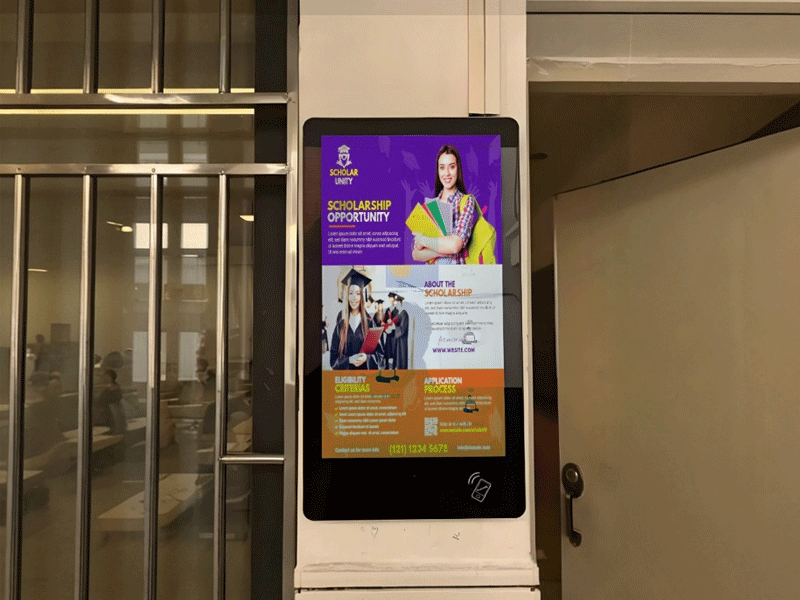
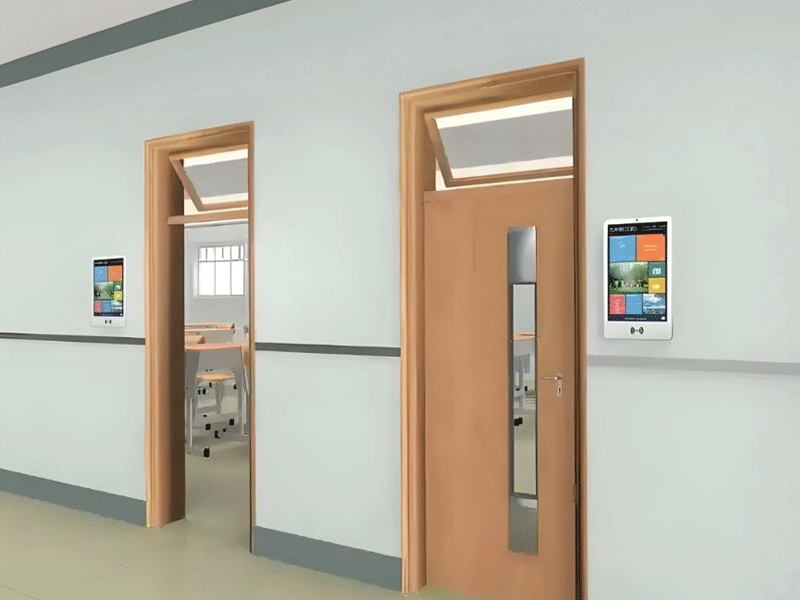
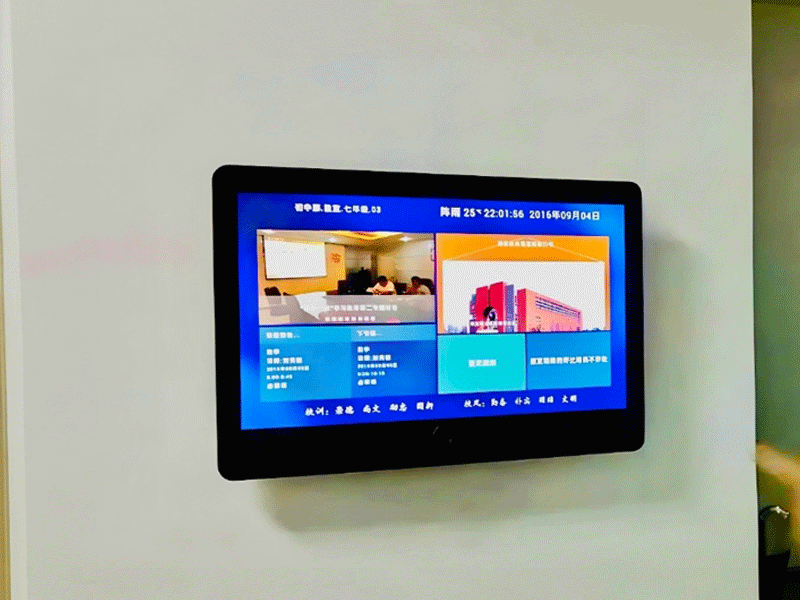

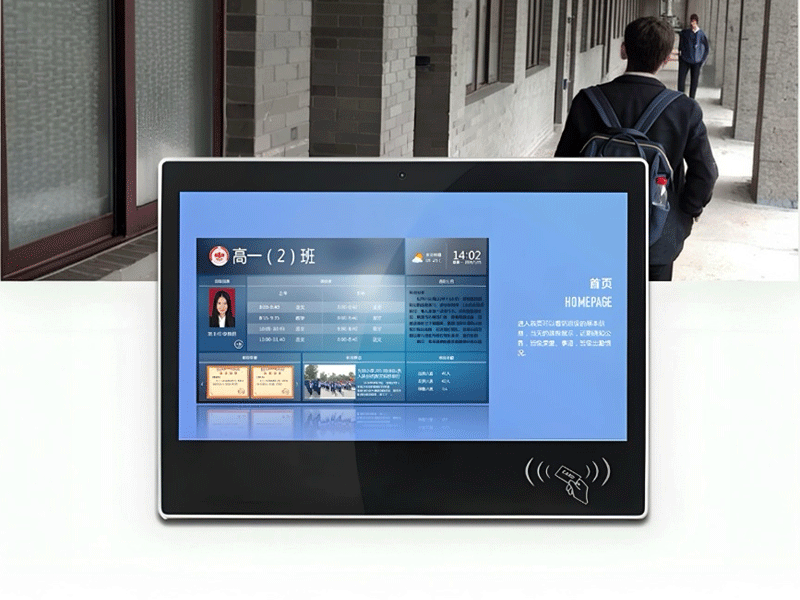
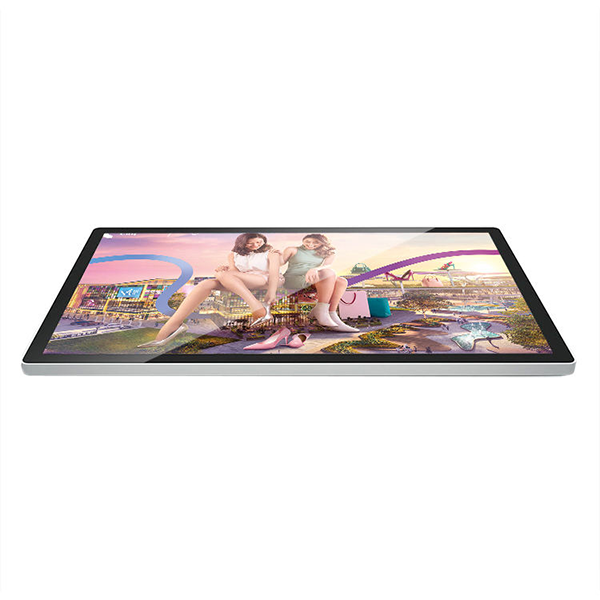
Advertising room board flat panel interactive android touch electronic class sign screen

electronic class sign-8
$350
Feature: dual up monitor;msi 32 inch curved monitor;computer monitors best buy;monitor buy
Size: 10.1'';13.3'';15.6'';19'';21.5'';27'';32'';50'';55'';18.5'';24'';43'';49'';20cmx20cm;25cmx25cm
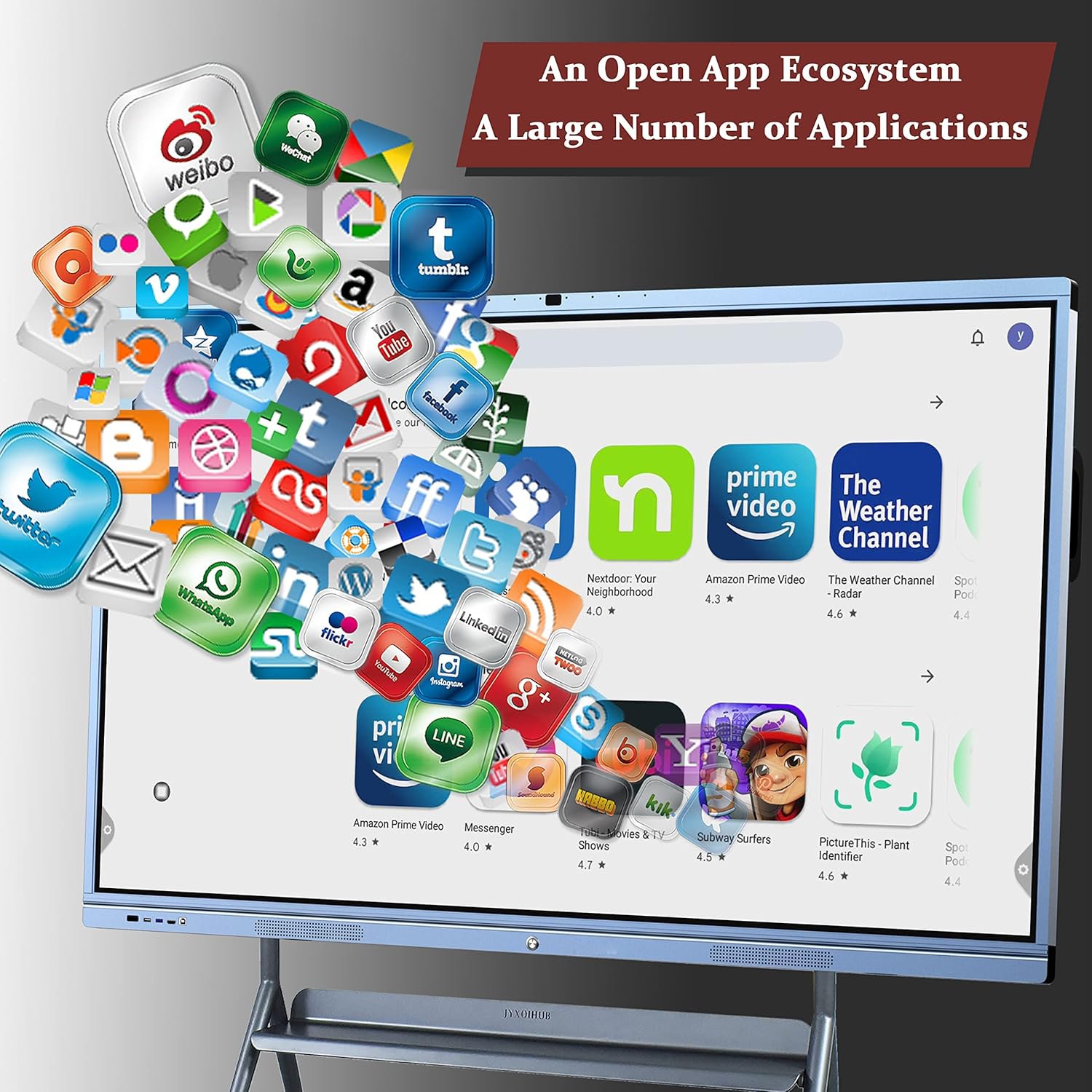
Operation System: Android;Windows
Screen: Touchscreen;Non-touch screen
Installation: Vertical;Horizontal;Wall-mounted;Portable
Type: Advertising Machine;Digital Signage Display;Teaching All-in-one Machine
Product Details
Product Details

White Paper on the Ultimate Durability Technology of Electronic Class Signs I. Technological Breakthroughs in Touch Durability (1) Innovation of Capacitive Touch Modules The fifth-generation projected capacitive technology (Projected Capacitive Technology) used in electronic class signs has achieved a revolutionary breakthrough: Diamond-grade ITO coating (thickness 150nm) with a hardness of Mohs 8 Nano silver wire grid electrode (line width 3μm) increases conductivity by 300% After 35 million touch tests, the linearity error is still 50N/cm²) Frame buffer silicone (hardness 60 Shore A) Absorbs 90% of impact energy Anti-false touch algorithm filters invalid operations, extending the effective touch life by 5 times
II. Durability verification in harsh environments

(1) Accelerated aging test system

Robotic arm touch test: 10 million times/month (force 250g, speed 3 times/second)

Touch accuracy change <2% after 1000 extreme temperature cycles (-40℃~85℃)

85℃/85%RH high temperature and high humidity test for 1000 hours, zero functional failure

(2) Actual scenario data tracking

Three-year usage data of a key middle school shows:

Average daily touch times: 427 times (peak 2100 times)

Cumulative touches in 3 years: about 470,000 times

Performance degradation rate: 0.003%/100,000 times (far better than the industry standard of 1%)

III. Ultra-long life of core components

( 1) Industrial touch IC solution

Using automotive-grade chips (AEC-Q100 certified)

Contact scanning frequency 1kHz (5 times that of consumer-grade products)

Signal-to-noise ratio >60dB (ensuring stability in high-interference environments)

(2) Application of special materials

Touch electrodes use graphene-silver composite materials (anti-oxidation life increased by 10 times)

Surface anti-fingerprint coating (contact angle 115°, still effective after 100,000 wear tests)

Anti-glare etching process (haze 23%±2%, no attenuation in 10 years)

IV. Intelligent system behind durability

(1) Self-repair algorithm

Automatic calibration of contact drift (accuracy ±0.5 pixels)

Dynamic compensation for electromagnetic interference (suppression of more than 50dB)

Wear leveling technology (disperse operation hotspots to the entire panel)

(2) Health monitoring

Real-time impedance detection (accuracy 0.1Ω)

Capacitance value change tracking (sensitivity 1fF)

Predictive maintenance reminder (accuracy 98.7%)

(3) Teaching scene optimization

Glove touch mode (support 3mm thickness)

Wet hand operation recognition (water drop interference suppression> 30dB)

Multi-person simultaneous touch (maximum support 20 points)

VII. Full life cycle cost analysis

(1) 10-year total cost

Equipment purchase cost: baseline value

Maintenance and replacement costs: reduced by 80%

Energy consumption cost: saved by 45%

Comprehensive benefits: increased by 300%

(2) Actual case verification

A university smart classroom project:

Traditional equipment: touch module replaced 3 times in 5 years

This product: zero replacement in 5 years

VIII. Future technology evolution direction

(1) Self-healing material application

Microcapsules Conductive polymer (scratch automatic repair)

Shape memory alloy electrode (99% deformation recovery rate)

Photocatalytic self-cleaning coating (ultraviolet trigger)

(2) Quantum dot touch technology

Sensitivity increased to 0.01g pressure sensing

Theoretical life exceeds 100 million touches

Energy consumption reduced to 30% of existing solutions

Test data from the Equipment Center of the Ministry of Education shows that electronic class signs with a life of 35 million touches can meet the following requirements:

Primary and secondary schools: about 25 years of use (400 times per day)

Colleges and universities: about 15 years of use (800 times per day)

Public places: about 10 years of use (1,200 times per day)

This durability, which exceeds the industry standard by 7 times, not only significantly reduces the total cost of ownership (TCO), but also ensures the continuity of teaching activities through stable performance. An evaluation report by a provincial education department pointed out that after adopting high-durability electronic class signs, course interruptions caused by equipment failures were reduced by 92%, and teacher and student satisfaction increased by 40%, becoming a benchmark solution for the Education Informatization 2.0 Action.
We use cookie to improve your online experience. By continuing to browse this website, you agree to our use of cookie.

Cookies

Please read our Terms and Conditions and this Policy before accessing or using our Services. If you cannot agree with this Policy or the Terms and Conditions, please do not access or use our Services. If you are located in a jurisdiction outside the European Economic Area, by using our Services, you accept the Terms and Conditions and accept our privacy practices described in this Policy.
We may modify this Policy at any time, without prior notice, and changes may apply to any Personal Information we already hold about you, as well as any new Personal Information collected after the Policy is modified. If we make changes, we will notify you by revising the date at the top of this Policy. We will provide you with advanced notice if we make any material changes to how we collect, use or disclose your Personal Information that impact your rights under this Policy. If you are located in a jurisdiction other than the European Economic Area, the United Kingdom or Switzerland (collectively “European Countries”), your continued access or use of our Services after receiving the notice of changes, constitutes your acknowledgement that you accept the updated Policy. In addition, we may provide you with real time disclosures or additional information about the Personal Information handling practices of specific parts of our Services. Such notices may supplement this Policy or provide you with additional choices about how we process your Personal Information.


Cookies

Cookies are small text files stored on your device when you access most Websites on the internet or open certain emails. Among other things, Cookies allow a Website to recognize your device and remember if you've been to the Website before. Examples of information collected by Cookies include your browser type and the address of the Website from which you arrived at our Website as well as IP address and clickstream behavior (that is the pages you view and the links you click).We use the term cookie to refer to Cookies and technologies that perform a similar function to Cookies (e.g., tags, pixels, web beacons, etc.). Cookies can be read by the originating Website on each subsequent visit and by any other Website that recognizes the cookie. The Website uses Cookies in order to make the Website easier to use, to support a better user experience, including the provision of information and functionality to you, as well as to provide us with information about how the Website is used so that we can make sure it is as up to date, relevant, and error free as we can. Cookies on the Website We use Cookies to personalize your experience when you visit the Site, uniquely identify your computer for security purposes, and enable us and our third-party service providers to serve ads on our behalf across the internet.

We classify Cookies in the following categories:
 ●  Strictly Necessary Cookies
 ●  Performance Cookies
 ●  Functional Cookies
 ●  Targeting Cookies


Cookie List
A cookie is a small piece of data (text file) that a website – when visited by a user – asks your browser to store on your device in order to remember information about you, such as your language preference or login information. Those cookies are set by us and called first-party cookies. We also use third-party cookies – which are cookies from a domain different than the domain of the website you are visiting – for our advertising and marketing efforts. More specifically, we use cookies and other tracking technologies for the following purposes:

Strictly Necessary Cookies
These cookies are necessary for the website to function and cannot be switched off in our systems. They are usually only set in response to actions made by you which amount to a request for services, such as setting your privacy preferences, logging in or filling in forms. You can set your browser to block or alert you about these cookies, but some parts of the site will not then work. These cookies do not store any personally identifiable information.

Functional Cookies
These cookies enable the website to provide enhanced functionality and personalisation. They may be set by us or by third party providers whose services we have added to our pages. If you do not allow these cookies then some or all of these services may not function properly.

Performance Cookies
These cookies allow us to count visits and traffic sources so we can measure and improve the performance of our site. They help us to know which pages are the most and least popular and see how visitors move around the site. All information these cookies collect is aggregated and therefore anonymous. If you do not allow these cookies we will not know when you have visited our site, and will not be able to monitor its performance.

Targeting Cookies
These cookies may be set through our site by our advertising partners. They may be used by those companies to build a profile of your interests and show you relevant adverts on other sites. They do not store directly personal information, but are based on uniquely identifying your browser and internet device. If you do not allow these cookies, you will experience less targeted advertising.

How To Turn Off Cookies
You can choose to restrict or block Cookies through your browser settings at any time. Please note that certain Cookies may be set as soon as you visit the Website, but you can remove them using your browser settings. However, please be aware that restricting or blocking Cookies set on the Website may impact the functionality or performance of the Website or prevent you from using certain services provided through the Website. It will also affect our ability to update the Website to cater for user preferences and improve performance. Cookies within Mobile Applications

We only use Strictly Necessary Cookies on our mobile applications. These Cookies are critical to the functionality of our applications, so if you block or delete these Cookies you may not be able to use the application. These Cookies are not shared with any other application on your mobile device. We never use the Cookies from the mobile application to store personal information about you.

If you have questions or concerns regarding any information in this Privacy Policy, please contact us by email at . You can also contact us via our customer service at our Site.