



How to solve the common faults encountered in splicing screens
Nov .17.2025
pemandangan
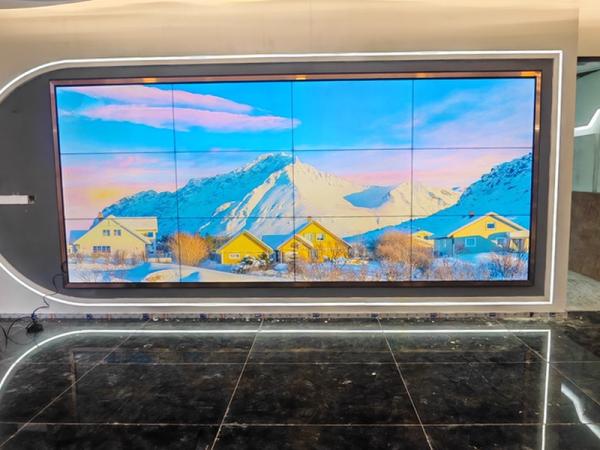
Second, the splicing screen is white.
A. The phenomenon that the splicing screen is white indicates that the backlight panel can work normally. First, judge whether the motherboard can work normally. Press the power switch to check whether the indicator light responds. If the indicator light can change color, it means that the motherboard is working normally.
1. Check whether the connecting cable of splicing screen motherboard signal output to the screen is in poor contact (the connecting cable or screen can be replaced).
2. Check whether the voltage of each working point of the motherboard is normal, especially the power supply voltage of the panel.
3. Check the line field signal and clock signal (from input to output) with an oscilloscope.
B. If the splicing screen indicator does not respond or is not lit, it indicates that the motherboard is not working normally. 1. Check the voltage of each operating point of the motherboard, and pay attention to EEPROM voltage (about 4.8V), reset voltage (high or low level, depending on the model) and MCU voltage. If the power supply is short-circuited, please look for the short-circuit position carefully, which may lead to the short-circuit of the copper foil of the printed circuit board.
2. Find out whether the MCU pin is in good contact with the motherboard.
3. Check whether the splicing screen motherboard chip and single chip microcomputer work, and measure whether the crystal oscillator starts to vibrate with an oscilloscope.
4. If necessary, replace the single chip microcomputer or re-burn the single chip microcomputer.
Third, splicing screens.
1. Measure whether the clock output of the splicing screen motherboard is normal.
2. Check the circuit of splicing screen motherboard signal RGB from the input to the main chip (whether there is a virtual welding short circuit, whether there is a capacitor resistance error).
3. Check whether there is a virtual welding short circuit (IC pin arrangement and double pin arrangement, especially the flat socket) in the connector circuit from the signal output of the splicing screen motherboard to the output to it.
4. Replace the screen if necessaryFourth, the two-color indicator light of splicing screen is not lit or has only one color.
1. Check whether the triode level output to the indicator light controlled by the single-chip microcomputer of splicing screen is normal, which is usually 3.3V at high level and 0V at low level. When the machine is turned on and off, these two levels will become opposite. If it is abnormal, check whether there is short circuit and virtual welding between the circuit and the single chip microcomputer.
2. Check whether the power supply voltage (5V) of the splicing screen triode is normal and whether the output of the triode is normal. The voltage across the indicator lamp can be measured.
3. Check whether the motherboard socket of splicing screen is in poor contact with the keyboard, and whether the circuit board is short-circuited to ground.
4. It is necessary to replace the indicator light.
Fifth, the splicing screen is color cast.
1. Check the circuit of splicing screen motherboard signal from input to main chip (whether there is virtual welding short circuit and whether the values of capacitor and resistor are wrong).
2. Enter the factory mode, adjust the white balance, and adjust the normal color.
3. If necessary, replace the splicing screen microcontroller or re-burn the microcontroller.
Sixth, there is no signal on the splicing screen.
A. there is no input signal after power-on.
1. Check the VGA cable connection.
2. Check the circuit from the input of the line field of the splicing screen motherboard (note whether there is a short circuit between the line field of the VGA mother seat and the ground) to the output of the inverter and then to the main chip (whether there is a virtual welding short circuit and whether the capacitance and resistance value are wrong).
3. Check the voltage of each working point of the splicing screen motherboard (the main chip may be damaged).
B, beyond the display after boot
1. Check whether the computer input signal is out of range.
2. Check the voltage of each working point of the splicing screen motherboard (the main chip may be damaged).
3. Whether the "phase" can be adjusted by automatic adjustment or manual adjustment.
4. Check the voltage of each working point of the motherboard (the main chip may be damaged).
5. Check whether the capacitance resistance of the phase-locked loop has an error value.
6. Check the circuit from the input of the line field to the output of the inverter and then to the main chip (whether there is a virtual welding short-circuit capacitor resistance or not, and whether there is an error value). VII. Double images
1. Check whether the input signal is caused by connection and distribution, or whether the VGA cable does not meet the specifications.
2. Check whether the VGA seat of the splicing screen motherboard has virtual welding or even welding.
3. Check the circuit from splicing screen signal input to the chip for virtual welding, short circuit and capacitor resistance error.
Sebelumnya :
Maintenance of LCD splicing screen
Selanjutnya :
Skills of preventing electrostatic interference of LCD splicing screen
Berita Terkait

P2.5 LED poster screen display machine fully assembled (A)
Jun .20.2026
Welcome Middle Eastern customers to come and inspect the LED poster screen display machine.
Indoor P4 LED display screen machine: magnetic suction simple box workshop assem
Jun .19.2026
Application scenariosCommercial retail fieldMall atrium: LED display screen machine is used for brand promotion and promotional information display.
Indoor P4 LED display screen machine: magnetic suction simple box workshop assem
Jun .18.2026
Typical caseUpgrading project for digital signage LED screen display machines in shopping malls.
Indoor P4 LED display screen machine: magnetic suction simple box workshop assem
Jun .17.2026
Product definitionThe indoor P4 LED display machine is a high-definition display device designed specifically for indoor environments.